Turtle Island Restoration Network
Olema, CA
$100,000 Impact Grant (2024-2026)
Turtle Island Restoration Network - Olema, California
Muir Woods Restoration Project

TIRN’s mission is to mobilize people in local communities around the world to protect marine wildlife and the oceans and inland watersheds that sustain them.
For over 30 years, Turtle Island Restoration Network (TIRN) has been a leading advocate for the world’s oceans and marine wildlife. Begun as an effort to save hundreds of thousands of sea turtles and other marine species through hands-on conservation, policy change, and consumer change campaigns TIRN over the years grew to include another program focused on an issue close to the organization’s headquarters in the San Francisco Bay Area – California’s endangered wild coho salmon.
The Foundation’s $100,000 Impact Grant is funding work to be accomplished by the Salmon Protection and Watershed Network (SPAWN), a program under TIRN that has produced measurable gains over the past 20+ years through partnerships with state and federal agencies, local organizations, and landowners. TIRN-SPAWN outreach and education programs engage hundreds of people each year in the San Francisco Bay Area to learn about endangered Coho salmon and the urgency of saving this species through watershed restoration, native plant propagation, and riparian revegetation.
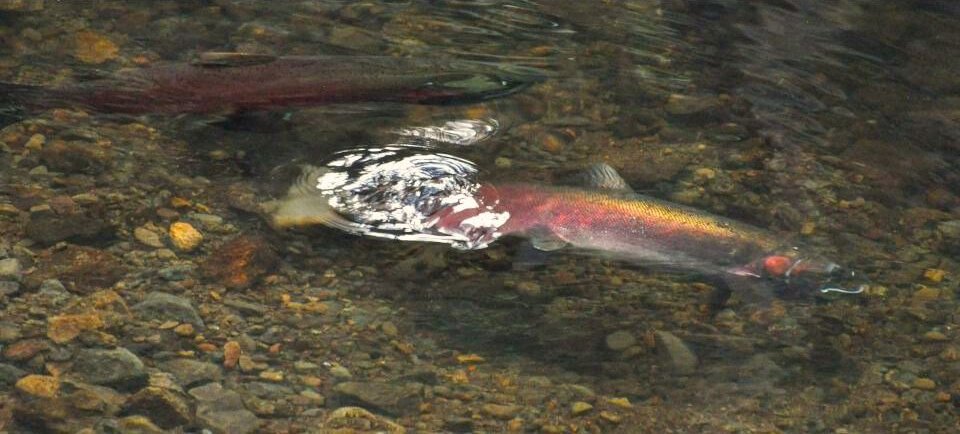
Underwater footage of endangered coho salmon in Lagunitas, CA. Turtle Island's Salmon Protection And Watershed Network (SPAWN) program is working to protect coho salmon and restore their habitat.
TIRN was incorporated in 1997 to protect marine wildlife, and ocean and inland watershed habitats. Salmon Protection and Watershed Network (SPAWN) is a program under TIRN that has produced measurable gains over the past 20+ years that have built partnerships with state and federal agencies, local organizations, and landowners. Through our outreach and education programs, we engage hundreds of people each year throughout the San Francisco Bay Area to learn about endangered coho salmon; watershed restoration, native plant propagation, and riparian revegetation; and the urgency of saving this species. Our volunteers and student interns become watershed restorationists and land stewards because of their active participation in our programs and projects.
The Muir Woods Restoration Project (MWRP) aims to restore and revitalize the Redwood Creek watershed, to provide a healthy habitat for salmon to thrive. More than 60% of the channel banks were hardened by installation of rock riprap in the 1930’s. Perhaps even worse, for most of the 20th century, NPS removed fallen trees from the channel with an intention to prevent overbank flows. However, this practice eliminated large, natural wooden structures that would have provided essential habitat conditions for juvenile coho- pools and cover.

In alignment with the Woodard & Curran Foundation’s priorities, the proposed project addresses the protection and management of critical watersheds in the face of climate change. The most acute climate change stressors in the project area are extreme temperatures, high winter flows from heavy rainfall, and warm dry summers with persistent drought. MWRP will strengthen resilience to climate change within the target habitat and the surrounding ecosystem by improving the area’s capacity for adapting to environmental changes. The introduction of small wood structures in the Redwood Creek watershed will create increased channel roughness which slows flow during heavy rains and backs water up, allowing fish to find refuge, conserve energy, and find food even during high water events.
TIRN/SPAWN has a long history of involving diverse community groups in our restoration work. Participation ranges from full-time career training of interns to school programs for children and education for the public, all providing watershed experiential education. MWRP will utilize these programs as we engage our community. Up to eight annual career development residential internships and four annual part-time high school and college student interns, as well as elementary and high school students and adult volunteers will be involved. TIRN/SPAWN engages underrepresented and underserved BIPOC communities in the San Francisco Bay in order to engage individuals who might not otherwise have access to this type of conservation work.