Florida Gulf Coast University Foundation
Fort Myers, FL
$100,000 Impact Grant (2026)
Florida Gulf Coast University Foundation
for the project
Southwest Florida Mangrove Restoration & Enhancement Dashboard Development
The Foundation is pleased to support Florida Gulf Coast University’s project “Southwest Florida Mangrove Restoration & Enhancement Dashboard Development” with a $100,000 Impact Grant.
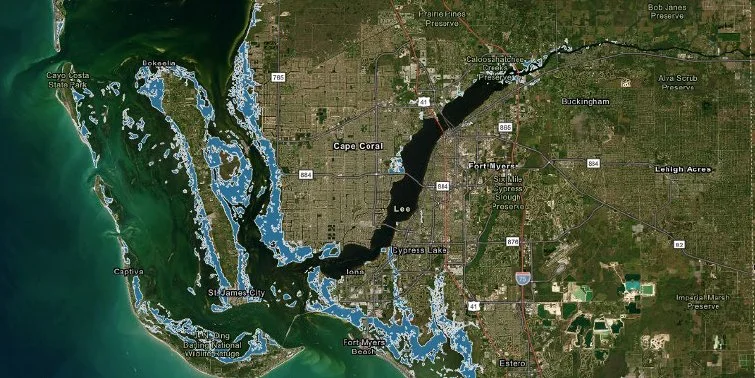
Mangrove forests are literally at the frontline of climate change stress, impacted by both sea level rise and more intense hurricanes. Coastal Lee County (Florida) is lined by these coastally important ecosystems (see below) that provide critical ecological and economic benefits across Southwest Florida, including flood-risk reduction, shoreline stabilization, coastal community protection, habitat support, and carbon storage, while also underpinning much of the region’s tourism economy. Mangrove ecosystems across Southwest Florida are increasingly degraded and fragmented due to sea-level rise, altered hydrology, and development. Since 2017, repeated hurricane impacts — including Irma (2017), Ian (2022), Helene (2024) and Milton (2024) — have further stressed these systems and nearby communities, compounding existing human pressures on the coastal landscape. As these pressures persist, the loss of the natural ecosystem services provided by mangroves, such as coastal protection and flood reduction, poses significant risks to local communities if they do not recover, or recover too slowly.
This project will provide a much-needed dashboard for agencies, universities and other actively engaged organizations to see the real time status of the mangrove forests/swamps that provide vital flood control functions. The mangroves have been heavily impacted by the severe hurricanes experienced in Florida over the past several years. The dashboard looks to provide not only the ability to monitor damaged areas, but also to manage undamaged areas and provide preventative maintenance as opposed to restoration.
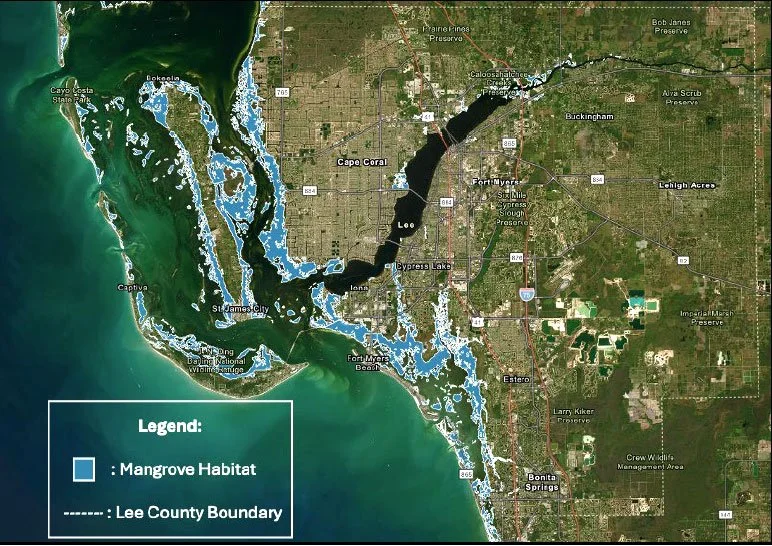
Mangrove Habitat, Lee County, Florida
Map of mangrove habitat (blue) coverage in Lee County Florida. Economically important mangroves occupy coastal wetland habitats along the coast and extend inland along canals and river systems. These systems provide communities important protection against flooding and storm impacts when healthy.
PROJECT TASKS + SCHEDULE
Task 1: Identification of Degraded and At-Risk Mangrove Areas (Months 1–3)
Compile and integrate publicly available and locally curated datasets, such as mangrove extent and change, flood exposure, sea-level rise projections, hydrologic alteration, and habitat connectivity.
Classify mangrove areas by condition (intact, degraded, fragmented, or highly stressed).
Identify mangrove areas where restoration or enhancement would provide the greatest resilience and ecological benefits.
Deliverable: Mangrove condition and risk classification framework and map.
Task 2: Prioritization Framework and Scoring System (Months 3–5)
Develop a multi-criteria scoring system ranking mangrove areas based on degradation, risk, flood-risk reduction potential, ecological benefits, feasibility, and funding readiness.
Distinguish sites appropriate for replanting, hydrologic reconnection, hybrid enhancement, or protection.
Deliverable: Finalized mangrove restoration and enhancement prioritization framework.
Task 3: Dashboard and Mapping Tool Development (Months 5–12)
Develop an interactive, web-based dashboard displaying prioritized mangrove areas.
Provide site-specific summaries of recommended actions, anticipated benefits, and constraints.
Deliverable: Beta Mangrove Restoration & Enhancement Planner.
Task 4: Partner Review, Refinement, and Implementation Support (Month 12)
Conduct review sessions with local governments, NGOs, and practitioners.
Refine the tool based on user feedback to support real-world decision-making.
Deliverable: Final public-facing dashboard.